Why This Matters If You're Taking a GLP-1 Medication
Semaglutide (sold as Ozempic and Wegovy) and tirzepatide (sold as Mounjaro and Zepbound) have changed what's possible for weight loss — but the weight that comes off isn't only fat. Clinical trials and real-world studies consistently show that a meaningful share of the weight lost on these drugs is lean mass, including muscle. The good news is that this isn't inevitable: research published through 2025 and 2026 points to protein intake and resistance training as the two levers that most reliably protect muscle while the drug does its job on fat.
This article lays out what the research actually shows about protein intake on a GLP-1 medication — not a generic "eat more protein" tip, but the specific numbers studies have tested, why appetite suppression makes hitting them harder, and practical ways to close the gap.
How Ozempic, Wegovy, and Mounjaro Actually Cause Weight Loss
GLP-1 receptor agonists (semaglutide) and dual GLP-1/GIP receptor agonists (tirzepatide) mimic a gut hormone your body already produces after eating. They work on two fronts at once: centrally, they act on appetite-regulating regions of the brain, and peripherally, they slow gastric emptying and reduce levels of ghrelin, the "hunger hormone." The combined effect is that food stays in your stomach longer, you feel full sooner, and your overall hunger drive drops.
That's precisely why these drugs are so effective for weight loss — and precisely why they create a nutrition problem. When appetite drops sharply, total food intake drops with it, and protein intake tends to fall along with everything else on the plate.
The Real Number: How Much of the Weight Lost Is Muscle?
Across major semaglutide and tirzepatide obesity trials, roughly 25–40% of total weight lost is lean mass, not fat. In the STEP 1 trial of semaglutide 2.4 mg, lean mass accounted for close to 39% of weight lost. A 2025 study presented at the Endocrine Society's ENDO meeting followed 40 adults with obesity for three months — 23 on semaglutide and 17 on a structured diet and lifestyle program — and found that roughly 40% of the weight lost in the semaglutide group came from lean mass.
That same study identified who is most at risk: the researchers found that "being older, female, or eating less protein was linked to greater muscle loss," and that losing more muscle was linked to smaller improvements in blood sugar control (HbA1c). Lead researcher Dr. Melanie Haines summarized the practical implication directly.
"Older adults and women may be more likely to lose muscle on semaglutide, but eating more protein may help protect against this." — Dr. Melanie Haines, Endocrine Society ENDO 2025
Not all GLP-1 drugs behave identically. Body-composition research comparing the two drug classes has found tirzepatide associated with somewhat greater relative lean-mass loss than semaglutide at matched time points — a gap of roughly 1–2 percentage points across 3 to 12 months of treatment. The difference is real but secondary to the bigger factor both drugs share: how much protein you're eating and whether you're doing any resistance training.
How Much Protein You Actually Need on a GLP-1 Medication
The standard RDA of 0.8 g of protein per kilogram of body weight was designed to prevent deficiency in sedentary people who aren't losing weight — it's a floor, not a target for this situation. Research specific to weight loss and GLP-1 therapy points meaningfully higher:
| Situation | Protein Target | Source |
|---|---|---|
| General sedentary adult (RDA floor) | 0.8 g/kg body weight/day | Standard Dietary Reference Intake |
| Adult actively losing weight | 1.2–1.6 g/kg body weight/day | Mayo Clinic Press |
| On a GLP-1 medication (case-series data) | 1.6–2.3 g/kg body weight/day | Case series, PMC (NIH) |
| Resistance-trained adults in a caloric deficit | up to 2.3–3.1 g/kg fat-free mass/day | ISSN Position Stand |
A 2025 case series published via the National Institutes of Health followed three patients on semaglutide or tirzepatide who combined higher protein intake with structured resistance training. Their results stood in sharp contrast to the trial averages: one patient lost only 8.7% of total weight as lean tissue (versus the typical 26–40%), and two others actually gained lean tissue while losing substantial body weight. Their reported protein intakes ranged from 1.6–2.3 g/kg/day, well above the RDA and above what most people eat by default while their appetite is suppressed.
Why Hitting Your Protein Target Gets Harder on These Drugs
This is the crux of the problem: the same appetite suppression that makes these medications effective for weight loss also makes it mechanically harder to eat enough protein. Mayo Clinic's clinical nutrition guidance is direct about this: "Because these medications reduce appetite, many people eat significantly less overall — including less protein." If you're eating two small meals a day instead of three normal ones, hitting 100+ grams of protein requires a different approach than it did before you started the medication.
Practical Ways to Close the Gap
- Eat protein first at every meal. With a smaller stomach capacity per sitting, prioritizing protein before carbohydrates or fat ensures it doesn't get crowded out once you feel full.
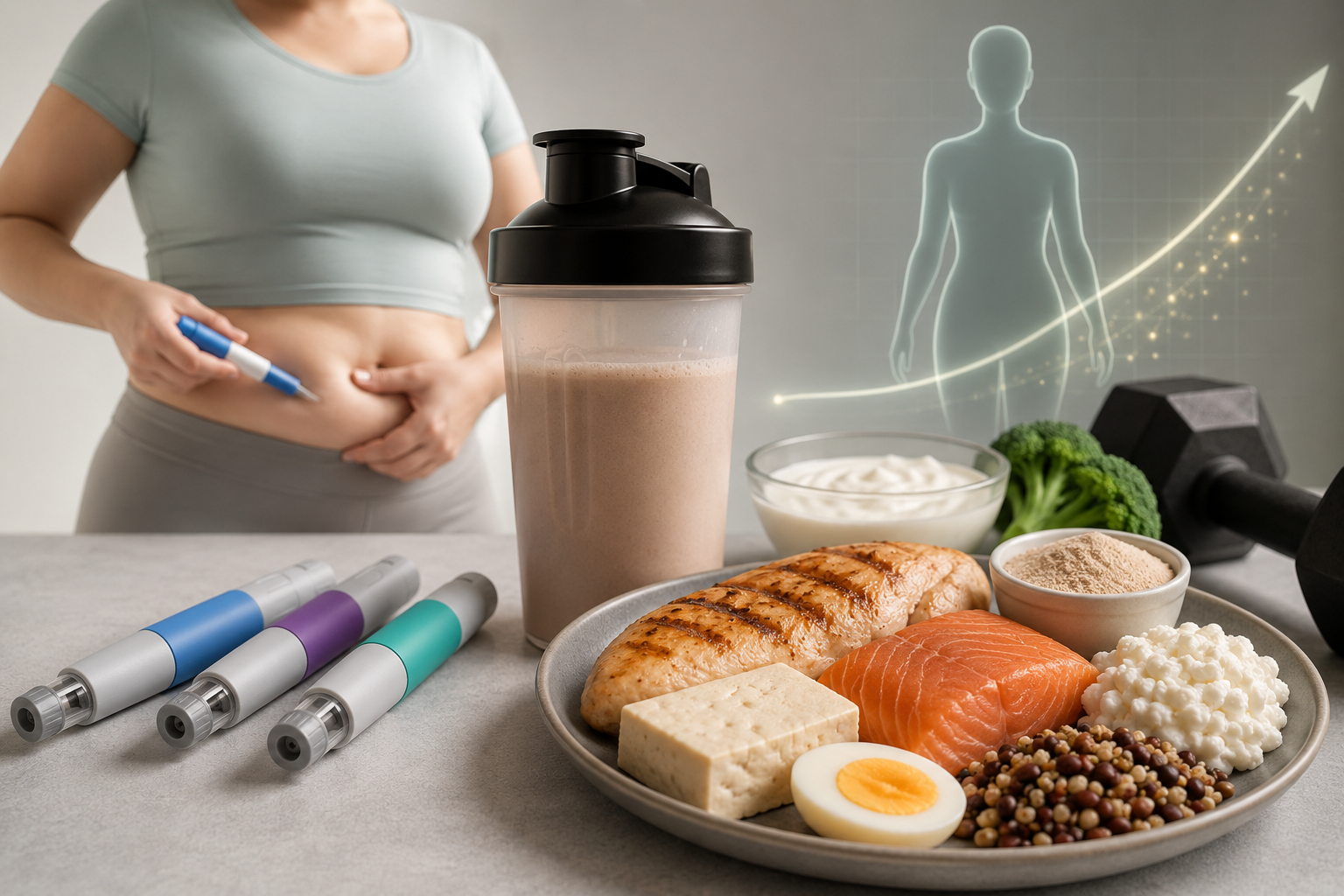
- Choose protein-dense whole foods. Eggs, fish, poultry, dairy (especially Greek yogurt and cottage cheese), legumes, and soy deliver more protein per bite than most other food groups — important when your total food volume is limited.
- Spread intake across the day. If large meals feel uncomfortable, smaller, more frequent protein-containing meals or snacks are easier to tolerate than trying to hit your target in one or two sittings.
- Use protein supplements to fill gaps, not replace food. Whey protein is the most extensively studied option for muscle support; pea and other plant-based proteins are a well-studied alternative for those who are dairy-free or vegan. Mayo Clinic's guidance frames these as tools that "work best to fill gaps when food intake is limited" — not a replacement for a protein-forward diet.
- Set reminders if appetite cues aren't reliable. Reduced hunger signaling means you can't always rely on feeling hungry to remind you to eat — tracking or reminder systems help close the gap consistently.
Protein Alone Isn't Enough — Resistance Training Is the Other Half
Every piece of research on this topic converges on the same conclusion: diet and exercise work together, not separately. The case-series patients who preserved or gained lean mass combined their higher protein intake with resistance training 3–5 days per week, targeting all major muscle groups at moderate-to-high intensity. Mayo Clinic's guidance is equally explicit that "protein alone is not enough" — muscle tissue needs a mechanical stimulus to be preserved, and resistance exercise (not cardio alone) provides that stimulus. Broader observational data backs this up: people who paired a structured diet with a workout plan retained 70–75% of their muscle mass during weight loss, and those working with fitness or medical professionals retained up to 85%.
This article is for general education and isn't a substitute for personalized medical or dietetic advice. Talk to your prescribing doctor or a registered dietitian before changing your protein intake significantly, especially if you have kidney disease or another condition that affects protein metabolism.
Sources
- Endocrine Society — "Consuming more protein may protect patients taking anti-obesity drug from muscle loss" (ENDO 2025)
- "Preservation of lean soft tissue during weight loss induced by GLP-1 and GLP-1/GIP receptor agonists: A case series" — PMC, National Institutes of Health
- Mayo Clinic Press — "GLP-1 Medications and Muscle Loss: What to Know About Nutrition and Supplements"
- "International Society of Sports Nutrition Position Stand: protein and exercise" — Journal of the International Society of Sports Nutrition, PMC
- "International Society of Sports Nutrition Position Stand: diets and body composition" — Journal of the International Society of Sports Nutrition, PMC
- "Effects of GLP-1 on appetite and weight" — PMC, National Institutes of Health